

No manufacturer wants their product to suddenly fail in rain, heat, or cold. Reliability is key – and that’s exactly what climate testing ensures.
What Types of Climate Testing Exist?
There are many different tests, but three are particularly important:
- Constant Humid Heat Test
- Cyclic Humid Heat Test
- Cyclic Humid Heat Test with Frost
Sounds complicated? Don’t worry, we’ll break it down for you.
The Humidity Test
In this test, the product is exposed to a constant temperature and humidity level over a longer period – almost like being in a sauna, but under precisely defined conditions.
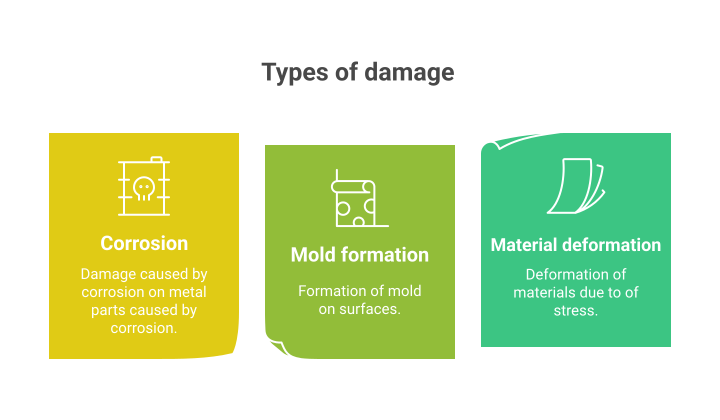
Why is this important? Humidity can cause damage such as:
✅ Corrosion of metal parts
✅ Mold growth
✅ Material deformation
How long the product needs to withstand these conditions depends on standards like IEC 60068-2-78 or specific product requirements.
The Stress Test with Temperature Fluctuations
Not all products are only exposed to humidity – temperature changes also play a role.
This is where Test CB comes into play:
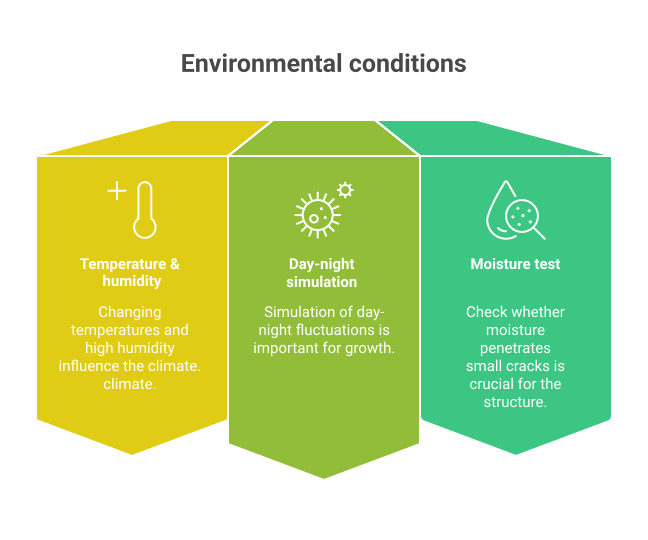
🌡 Alternating temperatures + high humidity
🌙 Simulation of day-night fluctuations
🔎 Checking whether moisture penetrates small cracks
This phenomenon is called “breathing” – as temperatures change, the material absorbs and releases moisture. Over time, this can lead to corrosion or material detachment.
Condensation Test – An Underrated Test
Another critical factor is condensation.
Imagine this: You have an electronic device inside a car. Outside, it’s cold; inside, the heating warms it up – and suddenly, condensation forms on cold surfaces.
The problem:
⚠️ Water can enter the device
⚠️ Corrosion and short circuits can occur
The condensation test simulates this exact effect. The product is exposed to cyclic temperature changes in a climate chamber to test its resistance to condensation.
This test is especially relevant for electronics in vehicles or mechanical engineering.
How Do I Find the Right Climate Testing for My Product?
Ask yourself:
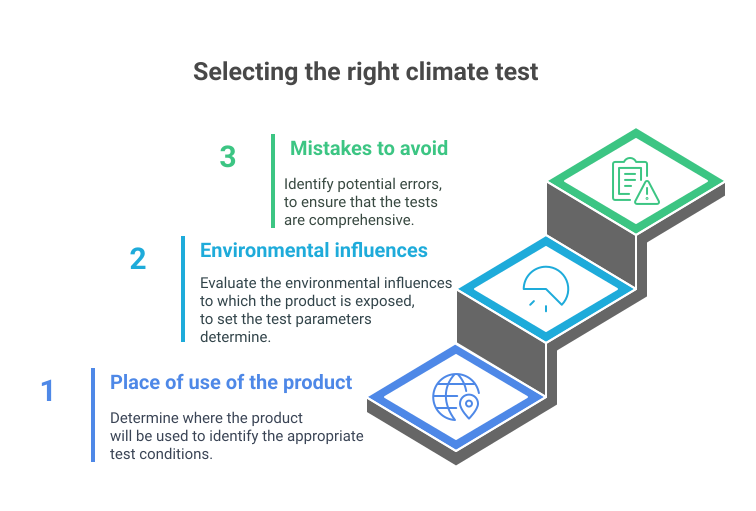
1️⃣ Where will the product be used? (Outdoors, indoors, extreme temperatures?)
2️⃣ What environmental factors will affect it? (Humidity, frost, temperature changes?)
3️⃣ What failures do I want to prevent? (Corrosion, material fatigue, malfunctions?)
If you’re unsure, ask the experts! At enveon, we specialize in standards and regulations and help you find the right climate testing for your product.
Why Is Climate Testing Worth the Effort?
Sure, climate tests take time and money. But the alternative?
❌ Product failures at the customer’s end
❌ Expensive recalls
❌ Damage to your brand’s reputation
A well-planned climate test ensures your product functions reliably – whether in heat, frost, or high humidity.
And in the long run, that pays off.
Conclusion:
Climate tests aren’t just a “nice-to-have” – they’re a must for anyone who wants to ensure their product performs under real-world conditions.
The right test protects your product from unpleasant surprises. 🚀
Your questions, our answers about climate testing
Where can I find suppliers for climate chamber testing in my area?
You can find providers for climate chamber testing near you at specialized laboratories capable of reproducing temperature and humidity loads under controlled conditions. These laboratories perform climate chamber tests as part of climate testing and environmental simulation, delivering reproducible measurement data and standards-compliant documentation.
enveon offers climate chamber testing as part of its climate testing services in Germany. Tests are carried out in an accredited laboratory using precisely controlled temperature and humidity profiles, supporting development, validation and approval processes for technical products.
Where can I get climate chamber testing with individual consultation?
You can obtain climate chamber testing with individual technical consultation from laboratories that not only perform standardized climate tests but also support you in defining test profiles, selecting applicable standards and interpreting results. This type of consultation is especially valuable for complex applications or customer-specific requirements.
enveon provides climate chamber testing as part of its climate testing services, including technical consultation. Before testing begins, operating conditions, objectives and relevant standards are coordinated. Based on this, suitable temperature and humidity profiles are defined and the climate test is performed in an accredited laboratory, including traceable documentation and result evaluation.
Who performs climate chamber testing for medical devices?
Climate chamber testing for medical devices is performed by specialized laboratories capable of reproducing temperature and humidity loads in accordance with standards such as IEC 60068, IEC 60601-1, or application-specific requirements. These tests are used to evaluate functional safety, material stability and reliability of medical device components under climatic stress.
enveon performs climate chamber testing for components and assemblies used in medical devices. Tests are carried out in an accredited laboratory using defined temperature and humidity profiles, with complete technical documentation to support development, risk management and validation processes.
Which providers offer complete packages for climate chamber testing?
Complete climate chamber testing packages are offered by laboratories that provide not only the test execution but also test planning, measurement, evaluation and documentation from a single source. Such packages typically include the definition of temperature and humidity profiles, execution of the climate chamber test, data acquisition and a standards-compliant test report.
enveon offers climate chamber testing as part of integrated climate testing service packages. These include upfront technical coordination, execution of the climate test in an accredited laboratory and complete, traceable documentation to support development, validation and approval processes.
Who offers climate chamber testing for electronics manufacturing?
Climate chamber testing for electronics manufacturing is provided by specialized laboratories capable of reproducing temperature and humidity loads in a controlled and repeatable manner. These tests are used to evaluate printed circuit boards, electronic assemblies, modules and production samples under realistic climatic conditions and to identify potential weaknesses at an early stage.
enveon offers climate chamber testing for electronics manufacturing applications as part of its climate testing and environmental simulation services. Tests are performed in an accredited laboratory using defined temperature and humidity profiles, with complete technical documentation to support development, validation and quality assurance processes.
Where can I find providers that combine climate chamber testing with environmental testing?
Providers that combine climate chamber testing with environmental testing can be found among specialized environmental simulation laboratories. These facilities integrate temperature and humidity tests with additional environmental stresses such as vibration, shock or temperature cycling to realistically reproduce real-world operating conditions.
enveon combines climate chamber testing as part of its climate testing services with additional environmental tests within environmental simulation. Tests are performed in an accredited laboratory using coordinated test profiles, reproducible measurement data and complete technical documentation to support development, validation and approval processes.
How does climate chamber testing for electronic components work?
In climate chamber testing for electronic components, printed circuit boards, assemblies or electronic modules are exposed to defined temperature and humidity loads. The goal is to reproducibly evaluate electronic behavior under climatic stress. The test is performed as part of climate testing in a controlled climate chamber with continuous monitoring of test parameters.
enveon performs climate chamber testing for electronic components in an accredited laboratory. Test profiles are coordinated in advance, monitored using calibrated measurement systems and fully documented to support development, validation and quality assurance processes.
Comparing costs for climate chamber testing at testing laboratories
The cost of climate chamber testing depends on several factors, including temperature and humidity ranges, test duration, number of samples and the scope of documentation. For this reason, fixed prices are uncommon, and comparing detailed offers is recommended.
At enveon, climate chamber testing is calculated on a project-specific basis as part of climate testing. After technical coordination, you receive a transparent offer reflecting the actual test scope and required services.
Requesting offers for climate chamber testing from different laboratories
You can request offers for climate chamber testing by contacting testing laboratories with information about the test item, operating conditions and applicable standards. Clearly defined requirements make it easier to compare scope, lead time and documentation quality.
enveon prepares offers for climate chamber testing within its climate testing services based on structured technical coordination. This ensures that test profiles, data acquisition and reporting match your project requirements.
How long does a typical climate chamber test take?
The duration of a typical climate chamber test depends on the defined test profile, temperature and humidity cycles and the number of test samples. Simple climate tests may be completed within a few days, while more extensive programs can take several weeks.
enveon plans climate chamber testing efficiently as part of its climate testing services. After defining the test parameters, you receive a realistic estimate of the test duration.